

How to Tell If Your Knife Scales Are Stabilized
The short answer: you usually can't tell by looking, and that's by design. Here's what actually distinguishes stabilized wood, and the tests that do (and don't) work.
Why It's Hard to Tell by Eye
Stabilization happens inside the wood before it's ever cut into scales — the blank is vacuum-impregnated with acrylic resin, then heat-cured until the resin hardens inside the cell structure. It is not a surface coating, so it has no reliable effect on how the finished handle looks or feels from the outside.
The glossy, "plasticky" look people associate with stabilized wood actually comes from the topcoat finish applied after shaping — CA glue, polyurethane, lacquer, or wax. That same finish gets applied to raw wood handles too. A matte-finished stabilized handle and a glossy raw handle are both completely normal, which is exactly why "it doesn't look stabilized" isn't a valid test on its own.
Tests That Actually Work
Water-drop test (most reliable). Find a small unfinished spot — inside the handle against the tang, or inside a drilled pin hole — and place a drop of water on it. Raw wood will visibly darken and slowly absorb the water. Stabilized wood resists absorption; the resin has sealed most of the pores. This only works on bare, unfinished wood — testing through a topcoat finish won't tell you anything.
The tilt variant (the one we use ourselves): place the drop near the top of the scale and tilt it. On stabilized wood, the drop mostly runs down toward the bottom — some water will still get absorbed along the way even on genuinely stabilized wood, that's normal, but the bead keeps moving. On raw wood, the drop won't move at all; it sinks in immediately on contact, before you can even tilt it.
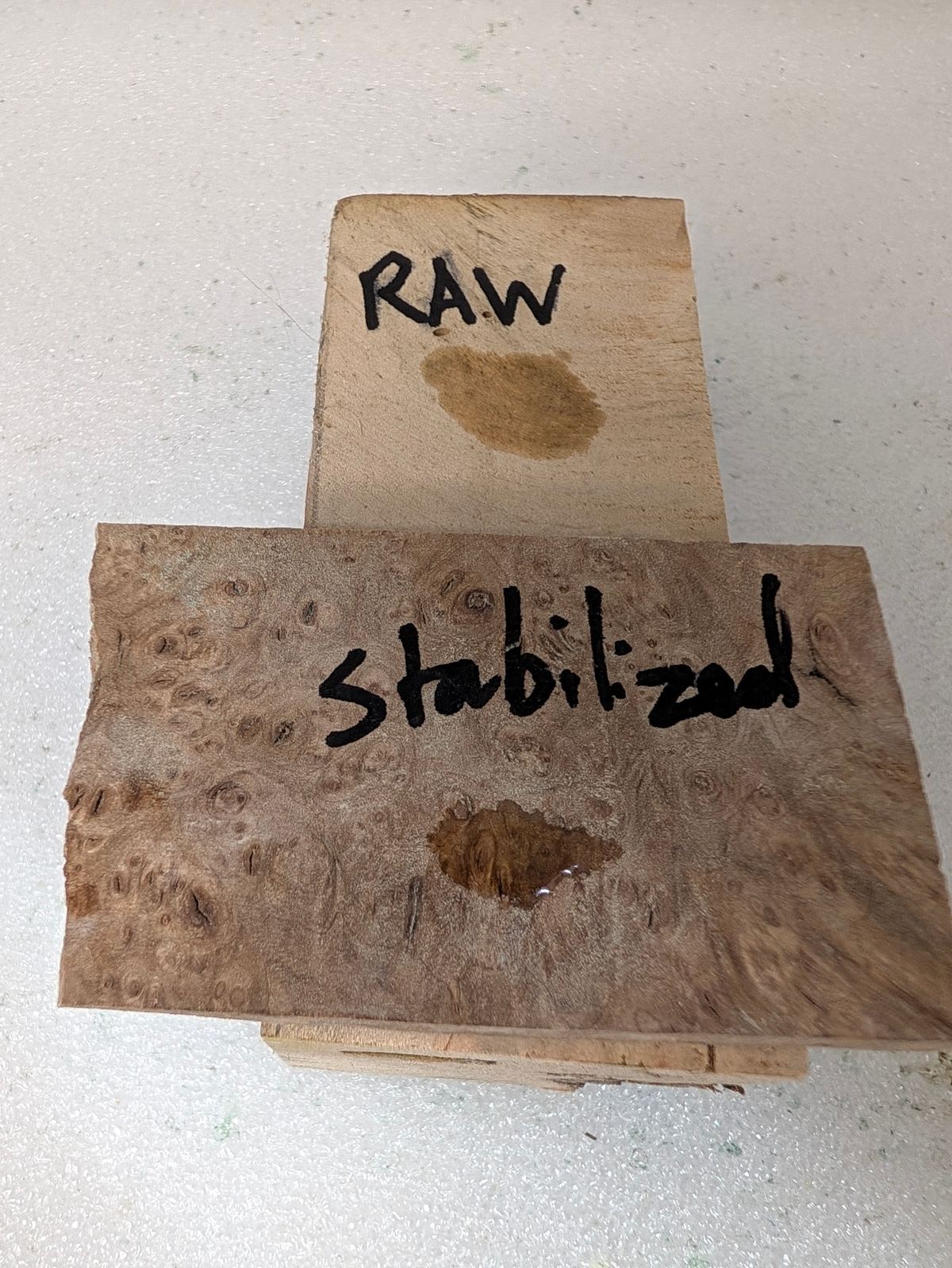
Weight, in aggregate. Stabilized wood is measurably denser than the same species raw, because the pores are filled with hardened resin instead of air. You won't feel this holding one handle, but if you ever compare two same-size blanks of the same species side by side — one raw, one stabilized — the stabilized one will noticeably outweigh the raw one.
Ask for proof. The single most reliable way to verify a handle is actually stabilized: ask the maker for process photos — the vacuum chamber, the resin used, the curing batch. A maker who actually stabilizes their own blanks can produce this easily and usually photographs batches as a matter of course.
Tests That Don't Work (Myths)
- "It should look glossy/plastic." That's the topcoat finish, not stabilization. Plenty of stabilized handles are finished matte.
- "It should feel different in the hand." The weight difference is real but small — a few grams on a finished handle, well below what anyone can reliably feel without a scale.
- Scratch, cut, or burn tests. These are destructive, give inconsistent results even on genuinely stabilized wood, and will void most return policies. Don't do these on a handle you plan to keep or return.
- Smell. Cured resin is largely odorless once fully set; the absence of a strong resin smell doesn't mean a blank wasn't stabilized.
When "Not Stabilized" Is Actually Correct
Some species are naturally dense or contain oils that block resin penetration entirely — stabilizing resin simply can't saturate them. These are correctly sold raw, and raw is the right form for them:
- Cocobolo — self-lubricating natural oils, extremely durable without treatment.
- Padauk, Tigerwood, Purpleheart, Bloodwood — dense enough (1,700–2,900 Janka) that stabilization isn't necessary.
If a handle in one of these species doesn't test as "stabilized," that's expected, not a defect — the wood is doing its job without it. See the full Stabilized vs Raw guide → for the complete species breakdown.
Frequently Asked Questions
- Should stabilized wood look glossy or plastic-like?
- No. That look comes from the topcoat finish applied after shaping — CA glue, polyurethane, lacquer, or wax — not from stabilization. Stabilization happens inside the wood's cell structure before it's ever cut, so it has no effect on surface shine by itself. A matte-finished stabilized handle and a glossy raw handle are both completely normal.
- Is stabilized wood always heavier?
- Slightly, yes — but not enough to tell by holding it. The resin fills internal pore space and adds a small amount of weight, more noticeably in soft, porous species. In a finished handle the difference is usually a few grams, well below what anyone can reliably feel without a scale.
- Can I test it myself with water or a scratch test?
- A water-drop test on an unfinished edge (inside the handle, against the tang, or a drilled pin hole) is the most reliable self-test — raw wood will darken and absorb the drop, stabilized wood won't. Scratch, burn, or cut tests are destructive, unreliable, and will void most return policies — don't do these on a handle you plan to keep.
- Why would a seller sell a knife as "stabilized" if some woods don't need it?
- Some species are naturally dense or oily enough (purpleheart, bloodwood, padauk, tigerwood, cocobolo) that stabilizing resin won't penetrate or isn't necessary — those are correctly sold raw, and raw is the right form for them. If a listing says stabilized for one of those species, ask what was actually done; for everything else, stabilized should mean a true vacuum/resin treatment before cutting.
- What's the single best way to verify a handle is stabilized?
- Ask the maker directly for proof — process photos of the vacuum chamber or curing batch, or documentation of the resin used. A maker who actually stabilizes their blanks can produce this easily. This is more reliable than any at-home test on a finished handle.